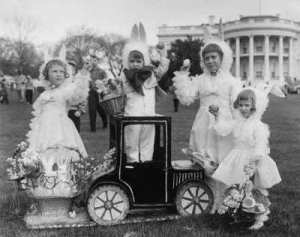
Since 1878, American presidents and their families have celebrated Easter Monday by hosting an 'egg roll' party. Held on the South Lawn, it is one of the oldest annual events in White House history. Some historians note that First Lady Dolley Madison originally suggested the idea of a public egg roll, while others tell stories of informal egg-rolling parties at the White House dating back to President Lincoln's administration. Beginning in the 1870s, Washingtonians from all social levels celebrated Easter Monday on the west grounds of the U.S. Capitol. Children rolled brilliantly dyed hard-boiled eggs down the terraced lawn.
Soon a concern for the landscape led to a bill that banned the rolling of eggs on Capitol grounds. In 1876, President Ulysses S. Grant signed the bill into law. The new edict went unchallenged in 1877, as rain cancelled all the day's activities, but egg rollers who came in 1878 were ejected by Capitol Hill police.
Since 1878, American presidents and their families have celebrated Easter Monday by hosting an 'egg roll' party. Held on the South Lawn, it is one of the oldest annual events in White House history. Some historians note that First Lady Dolley Madison originally suggested the idea of a public egg roll, while others tell stories of informal egg-rolling parties at the White House dating back to President Lincoln's administration. Beginning in the 1870s, Washingtonians from all social levels celebrated Easter Monday on the west grounds of the U.S. Capitol. Children rolled brilliantly dyed hard-boiled eggs down the terraced lawn.
Soon a concern for the landscape led to a bill that banned the rolling of eggs on Capitol grounds. In 1876, President Ulysses S. Grant signed the bill into law. The new edict went unchallenged in 1877, as rain cancelled all the day's activities, but egg rollers who came in 1878 were ejected by Capitol Hill police.
In 1878, Easter Monday celebrants who were not allowed to roll eggs on the grounds of the U.S. Capitol headed up Pennsylvania Avenue to the White House. The children knew about the low hills on the South Lawn, and hoped their egg rolling games would be permitted there. President Rutherford B. Hayes instructed his guards to let the youngsters through the gates. It proved to be a very popular change of venue. By Easter Monday 1880, an article in the Evening Star reported that eager egg rollers had taken "absolute possession of the grounds south of the White House."
In the beginning, children came into the White House with baskets of brightly dyed hard-boiled eggs. On Easter Monday, 1885, young egg rollers marched into the East Room, hoping for a personal audience with President Grover Cleveland. When he came down from his office to greet them, he was charmed, and indoor egg roll receptions became customary. These visitors ruined the East Room carpet, which, as the Washington Post reported, was "ground full of freshly smashed hard-boiled egg and broken egg shells." Still, when Cleveland returned in 1893 for a second, non-consecutive term, he continued to grant the egg rollers carte blanche access to the house and grounds.
Eleven years after the Easter Monday egg rolling festivities came to the White House, President Benjamin Harrison scored a hit by adding music to the affair. In 1889, he had the United States Marine Band, known as "The President's Own," play lively tunes while the children romped on the South Lawn. John Philip Sousa, who directed the band, took delight in treating the egg roll guests to rousing marches. Sousa honored the occasion in his 1929 composition "Easter Monday on the White House Lawn." U.S. Marine Band concerts were always a highlight of the event, and they continue to provide egg roll celebrants with music to make this day even more special.

Over the years, White House egg roll events have been made memorable by new attractions. In 1993, the Clintons scaled back the fanfare so that children would remember the day for its egg rolling games. A generation earlier, First Lady Pat Nixon gave out certificates of participation as a souvenir to eggrollers. Betty Ford and Rosalynn Carter distributed plastic eggs with printed notes inside from the first lady. In 1981, President and Mrs. Ronald Reagan hosted a hunt for wooden eggs that bore the signatures of famous people. Wooden eggs soon became the official White House egg roll keepsakes. The eggs are designed to reflect the special theme of each year's event, and are inscribed with the signatures of the president and first lady. Each child under the age of twelve is given one as he or she exits the South Lawn gates.
Have a happy Easter! Barb