Sunday, January 1, 2017

Our First Ladies Inaugural Ball Gowns

Inaugural Ball history
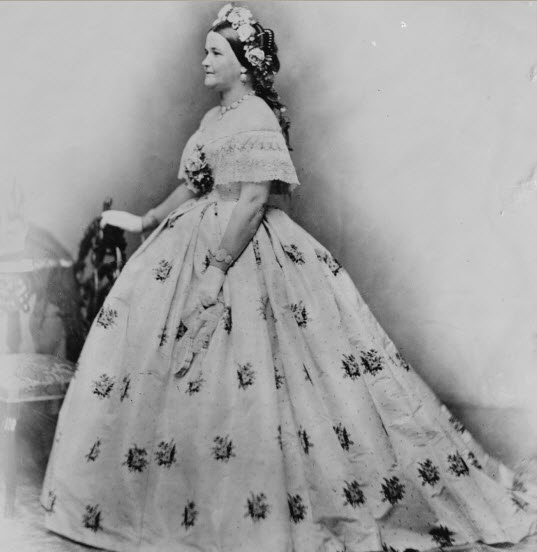
The Inaugural Ball has not been continuously held since before 1949. From 1789 until Franklin D. Roosevelt's fourth and final inauguration in 1945, only 14 First Ladies attended Inaugural Balls: Dolley Madison, Elizabeth Monroe, Louisa Adams, Sarah Polk, Harriet Lane (niece and First Lady of the only bachelor President), Mary Lincoln, Julia Grant, Lucy Hayes, Lucretia Garfield, Frances Cleveland, Caroline Harrison, Ida McKinley, Edith Roosevelt and Nellie Taft. A few First Ladies didn’t live long enough to see their husbands inaugurated or didn’t live in the White House.
With the Inauguration of Harry Truman in 1949, First Lady Bess Truman, got the tradition going as we know it today. Eleven different First Ladies have had Inaugural gowns (6 of them had two gowns each for their husbands' two inaugurations - Eisenhower, Nixon, Reagan, Clinton, Bush and Obama). Betty Ford never wore one since her husband became President upon the sudden resignation of Richard Nixon in 1974. Bess Truman and also Lady Bird Johnson didn’t wear one when their husbands were sworn in upon the death of the former presidents, FDRoosevelt, and JFKennedy.

Here are three First Lady gowns.

 Special thanks to the White House Historical Society.

Julia Grant                             


Lucy Hayes
Frances Cleveland
Sarah Polk


Sunday, November 20, 2016

Thanksgiving at the White House


Dwight Eisenhower
    

        Have you ever wondered how the national holiday began? 


          A woman author from New Hampshire, Sara Josepha Hale, was active in bringing to the attention of the American public, a day to give thanks. She had belonged to many socially active groups as well as benevolent societies. Ms. Hale also wrote for Godey’s Lady Book. She felt that with the abundant fall harvests of New England, there should be a common day of prayer instead of a different one for each state.


          Enter Abraham Lincoln and the symbolism of the United States, which alerted him to proclaim a national day of thanksgiving. On October 3, 1863, Abraham Lincoln established the last Thursday of November “as a day of Thanksgiving and Praise.”


Wednesday, September 28, 2016

Abraham and Mary's sweet tooth!

                                                              Mary Lincoln white cake.

     Tis the season of baking, so I thought my readers may want to know what tantalized Mr. Lincoln’s nose and made him drool.
     What better way to woo a man than through a delicious cake?  Mary Lincoln knew her husband liked sweets and he was particularly fond of a white cake, as well as apple pie.
       The cake recipe was supposedly created when Mary was young and part of the Todd legacy. She treasured the recipe and served it on special occasions in Springfield and at the White House. Mr. Lincoln would always comment, “Mary’s white cake is the best I have ever eaten.”
     President Lincoln also loved apples, and he enjoyed them served in a dish popular at the time: apple pie.  It appears he also had an affinity with rum because he liked a dollop of rum sauce on top of it.  Virginia Greening was the choice of apples.
     The Lincolns often had cookies in the cookie jar. When they were hosting a big party, they purchased macaroon pyramids (macaroon cookies stacked in a pyramid and covered with caramelized sugar drizzle) from local confectioners. Mary also served strawberries and cream, probably with cookies.
      Mrs. Lincoln baked cookies or doughnuts for the neighborhood children when they’d play with her boys.  She’d put copious amounts of sugar in them. During the course of one week in 1849, historians note that Mary purchased 13 pounds of sugar.

Mary Todd Lincoln’s White Cake 
(Recipe from Lincoln’s Table by Donna D. McCreary was adapted by Janice  Cooke Newman)
1 cup blanched almonds, chopped in a food processor until they
resemble a coarse flour
1 cup butter
2 cups sugar
3 cups flour
3 teaspoons baking powder
1 cup milk
6 egg whites
1 teaspoon vanilla extract
confectionary sugar
  • Preheat  oven to 350 degrees. Grease and flour a Bundt cake pan.
  • Cream  butter and sugar. Sift flour and baking powder 3 times. Add to creamed butter  and sugar, alternating with milk. Stir in almonds and beat well.
  • Beat  egg whites until stiff and fold into the batter. Stir in vanilla extract.
  • Pour  into prepared pan and bake for 1 hour, or until a toothpick inserted comes out  clean. Turn  out on a wire rack and cool. When cool, sift confectionary sugar over top
A basic white frosting sprinkled with almonds was also popular.
http://www.nps.gov/history/museum/exhibits/liho/printVersion.html


                                                                 Apple pie alamode                                                                 

Friday, May 7, 2010

Mary Lincoln: IF WORDS COULD KILL


MARY LINCOLN: The wife of the sixteenth president of the United States.
  I've wondered where to begin with Mrs. Lincoln so I think I'll give my readers a brief overview of her early life before she married Abraham, who truly was devoted to her. They were like night and day. In their case, opposites did attract.
   Mary was from an elite family. Her father, Robert Smith Todd, was an established banker, earning enough money to send not just his sons to school but also his daughters. Mary had twelve years of an education, which is unheard of in her day. Mary grew up mingling with powerful politicians such as Senator Henry Clay. Mary was vivacious, very bright, very interested in politics, very sociable. She became Abraham's intelligent and trustworthy informant about political issues. She knew just about everyone and had a wonderful sense of a person's character, if only her temper wouldn't get in the way. She had the Todd temper. One day she was gracious and kind, the next horrible.


    However, I believe, that Mary had good reason to be temperamental, but she did like the drama and carried her temper too far in a lot of cases. That being said, who could blame her? She had to deal with a husband that had homespun humor, and she was quite the refined woman. Besides having her husband shot, and who was sitting right beside her, she'd also lost two children by that time, and later her beloved, Tad. With the death of three children and one husband, all she had left was Robert, who committed her to a mental hospital. From what I've read, they were always estranged. Robert never understood his mother. She was neurotic with mild dementia plus eccentric. Abraham was gone most of the time, leaving her the parental duties plus taking care of the house. At home in Springfield, this meant milking the cows, etc, plus cooking. They were poor. Mr. Todd purchased their house for them.
   As you can see, my heart really does go out to Mary. I think history judges her too harsh and hopefully I can change the readers opinion about her, even if it's just a little bit.

Barb's Books

Please like my
Please follow:


Thursday, March 11, 2010

The Washington Monument


Washington Monument Dusk Jan 2006.jpg

Dolley on the far right at monument celebration.


As we all know, Dolley was the first First Lady to open the White House to the public, to let everyone see the President's House, thus began her road to fame. After James' death, Dolley personified the, 'old' guard, the relic of the Revolution. She knew everyone and everyone loved her, and she loved them. She returned to Washington after James's death where her fame increased overnight. She was the 'queen' of Washington, usurping all First Ladies living in the White House.
    When building the Washington Monument, they knew who to turn to for support, our Dolley. She had the qualities needed to raise the money, and advertisers focused on her graciousness and luster as a woman. She was genuine. She presented to Washington Society all that was good. Money was raised through fairs, fundraisers and other solicitations.
    Ladies from the Revolution were given homage. Beside her was the widow of Alexander Hamilton, she'd never remarried after husband was killed in that famous duel with Aaron Burr. John Quincy Adams' widow also attended. The two former First Ladies plus Mrs. Hamilton stood right out front as the parades marched, bands played and speeches were made, but all eyes were on one particular lady, Dolley. By now she was almost destitute, dressed in black from an earlier age but still looking as regal and beautiful as ever before, was Dolley. By now, the slave who had helped her save the Washington portrait, was giving her money for food.
    Railroad and coach fares were reduced for this event. People streamed in from far and wide to Washington to see what was happening and to witness Dolley laying the cornerstone of the monument. A 'delicious freshness' in the air captured Dolley as she smiled at them all. This beautiful eighty year old woman with the kind and gracious, gentle and forthright personality, had served, hosted, been invited, and enjoyed the company of everyone since the day of her birth and was loved by all.
    I like to think that she went home, poured a glass of wine, and said, 'Here's to ya, old girl! You done good!" She also would've had a twinkle in her eye.

My website:

http://www.barbaraschlichting.com
Please like my
Please follow: