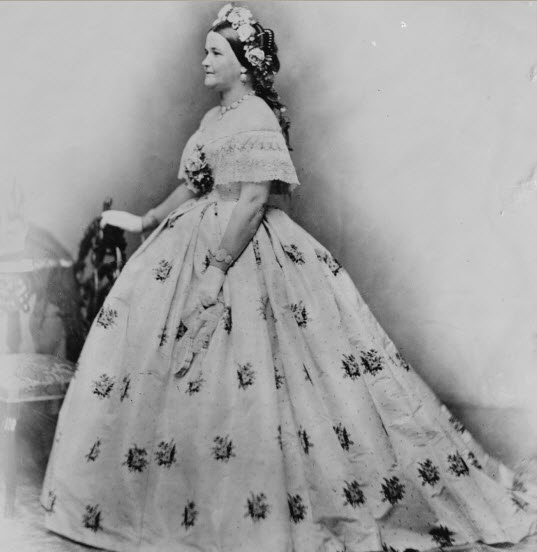
Edith
Kermit Carow Roosevelt
Edith Kermit Carow Roosevelt was the second wife and First
Lady of her childhood companion and the 26th President, Theodore Roosevelt
(1901-1909).
Edith Kermit Carow knew Theodore Roosevelt
from infancy; as a toddler she became a playmate of his younger sister Corinne.
Born in Connecticut in 1861, daughter of Charles and Gertrude Tyler Carow, she
grew up in an old New York brownstone on Union Square -- an environment of
comfort and tradition. Throughout childhood she and "Teedie" were in
and out of each other's houses.
Attending Miss Comstock's school, she
acquired the proper finishing touch for a young lady of that era. A quiet girl
who loved books, she was often Theodore's companion for summer outings at
Oyster Bay, Long Island; but this ended when he entered Harvard. Although she
attended his wedding to Alice Hathaway Lee in 1880, their lives ran separately
until 1885, when he was a young widower with an infant daughter, Alice.
Putting tragedy behind him, he and Edith
were married in London in December 1886. They settled down in a house on
Sagamore Hill, at Oyster Bay, headquarters for a family that added five
children in ten years: Theodore, Kermit, Ethel, Archibald, and Quentin.
Throughout Roosevelt's intensely active career, family life remained close and
entirely delightful. A small son remarked one day, "When Mother was a
little girl, she must have been a boy!"

Public tragedy brought them into the White
House, eleven days after President McKinley succumbed to an assassin's bullet.
Assuming her new duties with characteristic dignity, Mrs. Roosevelt meant to
guard the privacy of a family that attracted everyone's interest, and she tried
to keep reporters outside her domain. The public, in consequence, heard little
of the vigor of her character, her sound judgment, her efficient household
management.
But in this administration the White House
was unmistakably the social center of the land. Beyond the formal occasions,
smaller parties brought together distinguished men and women from varied walks
of life. Two family events were highlights: the wedding of "Princess
Alice" to Nicholas Longworth, and Ethel's debut. A perceptive aide
described the First Lady as "always the gentle, high-bred hostess; smiling
often at what went on about her, yet never critical of the ignorant and
tolerant always of the little insincerities of political life."

T.R. once wrote to Ted Jr. that "if
Mother had been a mere unhealthy Patient Griselda I might have grown set in
selfish and inconsiderate ways." She continued, with keen humor and
unfailing dignity, to balance her husband's exuberance after they retired in
1909.
After his death in 1919, she traveled abroad
but always returned to Sagamore Hill as her home. Alone much of the time, she
never appeared lonely, being still an avid reader -- "not only cultured
but scholarly," as T.R. had said. She kept till the end her interest in
the Needlework Guild, a charity which provided garments for the poor, and in
the work of Christ Church at Oyster Bay. She died on September 30, 1948, at the
age of 87.
During her time as FL, she was instrumental in changing the private residence. Security was lax and people would wander into the private residence so she removed the presidential staff from the second floor. She was also involved with the 1902 renovation and addition of the West Wing which gave it the classical look, and on the ground floor, the gallery of the First Ladies collection.
The biographies of the First Ladies on WhiteHouse.gov are from
“The First Ladies of the United States of America,” by Allida Black. Copyright
2009 by the White House Historical Association.
 |
| Alice Roosevelt |